

Jurnal Budget
Penulis:
Sekilas:
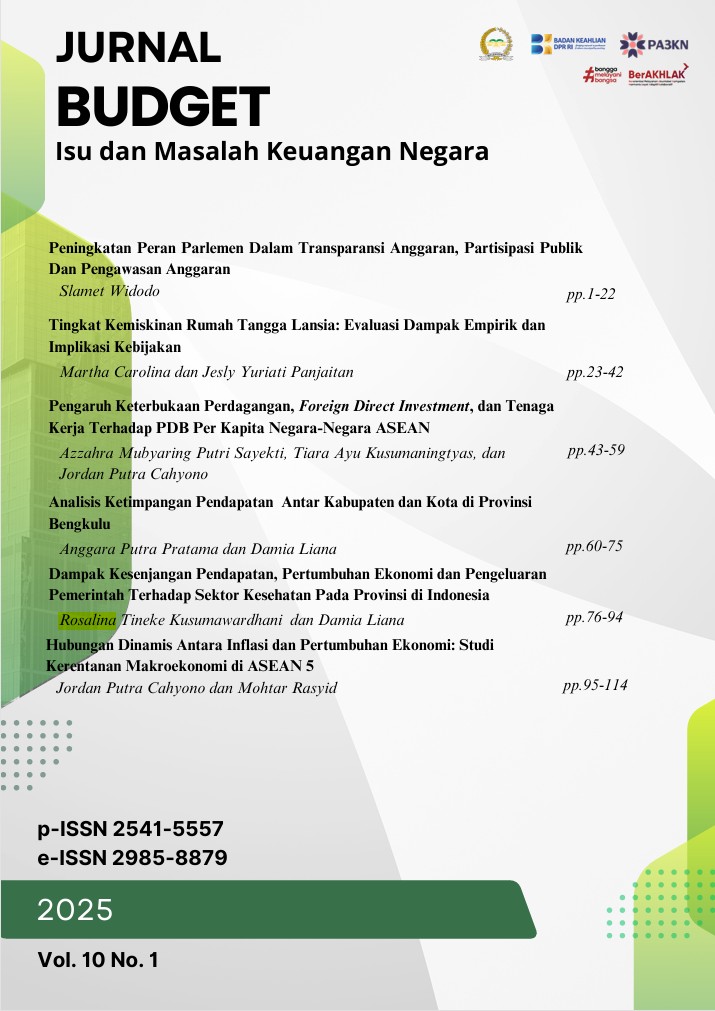
This study investigates the impact of income inequality, regional
economic growth, and government health expenditure on the
health across 34 provinces in Indonesia from 2018 to 2022. Using
a panel data regression with a fixed effects model, the results show
that income inequality has a negative and statistically significant
effect on the health sector, while economic growth and government
spending have positive and significant effects. Provinces with
higher income inequality tend to have lower health sector
performance, particularly in terms of health budget allocation and
public access to health services. In contrast, regions with sustained
economic growth and increased government health expenditure
experience improvements in health infrastructure and service
delivery. These findings suggest that narrowing income disparities
and maintaining consistent economic and fiscal support are
essential to improving health sector outcomes at the provincial
level in Indonesia. Policy interventions focusing on inclusive
economic development and equitable budget distribution can help
reduce regional disparities in health services.
Penulis:
Sekilas:
The results of the Open Budget Survey (OBS) in 2023
coducted by the International Budget Partnership (IBP)
showed that, the score for the transparency dimension did
not change from the 2021 survey, which amounted to 70.
The score for the public participation dimension increased
from 24 in 2021, to 26 in 2023. The score for the budget
oversight dimension decreased from 61 in 2021 to 59 in
2023 due to lack of evidence of session report of the
commitees both in areas of budget oversight and audit report
from State Audit Institution (SAI). This article aims to discuss
the results of OBS related to the Indonesian parliament and
relate them to the mechanism of parliamentary work and the
laws and regulations governing the implementation of
parliamentary duties. The research method used is
descriptive qualitative with the results of the 2023 OBS
questionnaire as the main document used in this research.
The results show that the parliament needs to improve its
mechanisms for periodic monitoring of SAI audit reports,
monitoring the implementation of the current fiscal year of
2025 and improving public participation mechanism in
budget discussions within and outside the APBN cycle.
Penulis: Martha Carolina, SE.,Ak., M. Ak. ❖ Jesly Yuriaty Panjaitan, S.E.Ak., M.M.
Sekilas:
Indonesia is undergoing a demographic transition marked by
a rising proportion of elderly populations, presenting
significant challenges to its economic system and social
welfare policies. This study aims to assess poverty levels
among elderly households and examine key determinants,
including education, health insurance coverage, social
assistance programs, and household structure. Utilizing 2024
Susenas data and Probit regression analysis, the findings
reveal that higher education and health insurance ownership
significantly reduce the likelihood of elderly poverty.
Conversely, participation in social assistance programs such
as the Program Keluarga Harapan (PKH) and Atensi Lansia
is positively associated with poverty status—indicating
accurate targeting, yet also underscoring persistent economic
vulnerability. Additionally, larger household sizes increase
poverty risk, while a greater number of working household
members reduces it. These results highlight the need for
holistic policy interventions—particularly in education, social
protection expansion, and economic empowerment for the
elderly—to mitigate the impact of population ageing and build
a more inclusive and sustainable social protection system.
Keywords: elderly poverty; aging population; social
protection; health insurance; education; household
vulnerability

Penulis:
Sekilas:
Penulis:
Sekilas:
Gedung Sekretariat Jenderal DPR RI, Lantai 6, Jl. Jend. Gatot Subroto, Senayan, Jakarta Pusat 10270. Telp. 021-5715.269 / 5715.635 / 5715.656 - Fax. 021-5715.635